
by Marta Cukierman
4 min read
by Marta Cukierman
4 min read

Modern websites aren’t built from one system anymore.
They’re made up of multiple systems that change independently. Content, commerce, search, personalization. Each moves on its own timeline, but all of it still has to come together as a single experience.
Most architectures handle that at request time. A user arrives, and the system pulls from multiple services, assembles a response, and relies on caching to make it fast enough.
That model works. But it’s also where a lot of the complexity comes from.
What gets cached, where it lives, how it’s invalidated. Why one region behaves differently than another. Why performance holds in one case and degrades in another.
Over time, teams spend more effort managing that than they expect.

Why is so much of the work happening when the user arrives?
Most of the data that shapes an experience already exists before the request. Content is published. Products are updated. Prices change. These are all signals that something should happen.
But the system waits. That gap is where a lot of the complexity lives.
StreamX was built around a different approach. Not optimizing what happens at request time, but reducing how much needs to happen then at all. We call this continuous materialization, shifting the work ahead of the request instead of into it.
StreamX's CTO, Michal Cuckierman, shared a bit more detail on this thinking recently here.
Up to now, using StreamX meant running it yourself.
Teams integrated it into their own environments, managed the infrastructure, and operated it alongside the rest of their stack. That worked, but it limited how quickly people could actually use it.
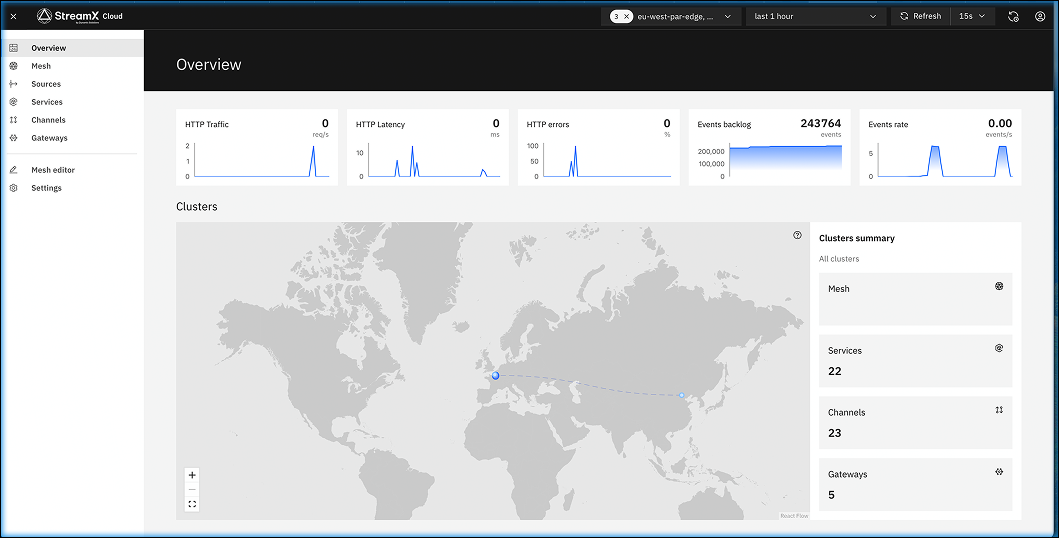
Now, StreamX is available as a cloud platform. You can create a project, connect your systems, and start pushing data without setting us the underlying infrastructure.
In practice, that changes how quickly teams can move from idea to something real. In one recent setup, we created a project and had a working site running in China in minutes, not weeks.
The model hasn’t changed. Access to it has. In practice, this means less dependency on what happens at request time, and more consistent behavior across regions and use cases.
This matters most in environments where the current model starts to break down.
China is one of the clearest examples. Systems like AEMaaCS or Edge Delivery Service (EDS) can’t be deployed inside mainland China, But, companies still need to serve those users. That usually leads to workarounds, added layers, and more complexity.
With StreamX, experiences can be generated from existing systems and delivered within China without exposing backend infrastructure or relying on those patterns.
.webp/jcr:content/renditions/original.webp)
We’re sharing this ahead of Adobe Summit. This will be our fourth year there. If you're attending we’d love to connect. Find us at booth 1052B.
As part of this, we’re opening a small number of projects through the StreamX Cloud Launch Program.
We created this program for teams with a defined use case who want to work through it with us and get to something real, not just explore it in isolation.
It starts with a focused evaluation and is designed to move quickly into a working implementation. Depending on the scope, we provide structured support and platform resources, including up to €50,000 in program support.
StreamX isn’t new. But making it available this way is.
If you want to be part of the first group building on the platform, apply to the Cloud Launch Program and we'll take a look together.